
HengOngBet Blog
HengOngBet Illusion of Control: Why Slots Feel Beatable in Malaysia
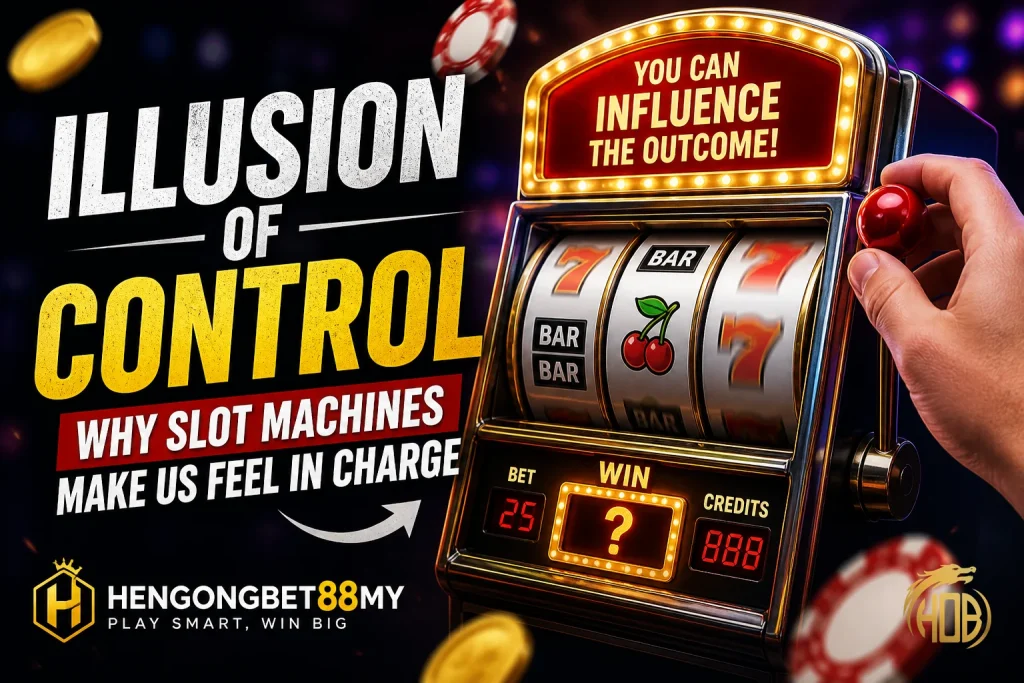

You tap the spin button yourself instead of using autoplay. You pick this machine because it “feels due.” You stop the reels a split second early because you swear it changes what lands. None of it does anything — the result was decided the moment you pressed spin — but it feels like it should. That feeling is called the illusion of control, and it is one of the most well-documented biases in gambling psychology.
What the Illusion of Control Actually Is
Psychologist Ellen Langer first defined the illusion of control in 1975 as the tendency to believe your personal odds of success are higher than they actually are, purely because the situation includes elements that resemble skill — choosing, timing, or acting — even when the outcome is entirely determined by chance. Langer’s original experiments showed that something as simple as letting a person choose their own lottery number, rather than being handed one, made them value the ticket more and behave as if their odds had improved. Nothing about the actual probability changed.
A 2025 review in Nature Reviews Psychology describes this bias using a simple comparison: pedestrian crossing buttons and lift “close door” buttons that are wired to do nothing. People press them anyway because doing something, however meaningless, feels better than doing nothing while waiting for an outcome you can’t influence. Online slots are built on exactly the same psychological wiring. Every spin, bet-line selection, and “stop” tap gives you the sensation of participating in the result — while the actual number that lands is generated by a random number generator the instant you press play, completely independent of anything you do afterward.
How Slot Design Feeds the Illusion Specifically
Slots are almost engineered to trigger this bias more than most casino games, for a few concrete reasons:
Manual spin vs autoplay. Choosing to tap “spin” yourself, rather than letting autoplay run, creates a feeling of active participation. Neither method changes the RTP or the outcome of a single spin in any way — the RNG result exists before your tap registers.
The “hot” and “cold” machine myth. Many Malaysian players believe a machine that “hasn’t paid out in a while” is due, or that a machine currently paying out is “hot” and worth chasing. Online slots have no memory of previous spins. Each result is generated independently, so a machine’s recent history has zero predictive value for the next spin — this is a close cousin of the gambler’s fallacy layered on top of the illusion of control.
Choosing bonus features or bet lines. Some slots let you pick which bonus round to enter or how many lines to activate. This choice architecture is deliberately designed to feel like strategy. In reality, the maths behind each option is fixed by the game’s paytable — you are choosing a flavour of randomness, not influencing your odds.
Descending win sequences early in a session. Research on outcome sequencing found that players who experience wins early in a session — even purely by chance — report significantly higher perceived control over later results than players whose wins come later or are spread evenly. An early lucky streak doesn’t mean you’ve “figured out” the game. It means you got lucky early, and your brain is now overconfident because of it.
Register at HengOngBet now and use demo mode to test this for yourself — you’ll see the same outcome distribution whether you tap manually, use autoplay, or “time” your spins.
The Malaysian Angle: Why This Bias Hits Harder Here
Malaysia has a long, culturally embedded relationship with number-picking games — 4D, Toto, and other lottery formats where choosing your own numbers is genuinely part of the ritual, even though the draw itself is random. That familiarity with “picking your own numbers” as a normal, socially accepted activity makes the jump to believing your choices matter in a slot game feel much smaller and more natural than it should. The mental habit transfers, even though the games work completely differently under the hood — a 4D draw and an RNG-based slot spin are both random, but slots add manual interaction (tapping, timing, choosing features) that lottery number-picking doesn’t have, which strengthens the false sense of participation even further.
Three Ways This Bias Costs You Real Money
1. You Increase Your Bet After a “Skill” Moment
If you stop the reels manually, pick a bonus round, or switch games because one “feels right,” and then win, your brain wrongly credits your decision instead of chance. The next natural step is betting more, because you believe you’ve found an edge. You haven’t — the win rate on the next spin is identical regardless of what you did on the last one.
What to watch for: Any bet increase that you can trace back to “because I did X and it worked” rather than a pre-planned staking rule is the illusion of control acting on you in real time.
2. You Play Longer Because You Feel “In the Zone”
A string of manual spins that go well can create a sense of rhythm or momentum — a feeling that you’re reading the game correctly. This is a purely psychological state with no basis in the actual maths, but it’s one of the strongest reasons sessions run long past a planned stop point.
What to watch for: If your reason for continuing to play is a feeling rather than your original session plan, that’s the signal to stop.
3. You Blame “Bad Timing” Instead of Accepting Ordinary Variance
When a manual stop or a chosen bonus round doesn’t pay off, players in this frame of mind often conclude they “timed it wrong” rather than accepting the outcome as ordinary bad variance. This keeps you chasing the feeling of correct timing rather than accepting that timing was never a real variable.
What to watch for: If a loss makes you want to try the “same move” again immediately to “get it right,” pause. There was no move — only a result.
Join for free today and check any game’s RTP and volatility rating before you play — that published number is the only real “edge” information available, and it has nothing to do with how you tap the screen.
How to Play Without Falling for It
- Separate the feeling of participation from the maths. Tapping, timing, and choosing are all real actions — they just don’t affect an RNG result. Accepting that consciously reduces the pull of the bias.
- Set your stake before you start and don’t revise it mid-session based on how a spin “felt.” Only revise it based on your pre-planned bankroll rules.
- Check RTP and volatility, not “hot streak” folklore. The UK Gambling Commission requires licensed operators to certify RNG fairness independently — the published RTP is the only number that reflects the game’s real long-run behaviour.
- Use a session timer instead of judging when to stop by feel. “I’m in control right now” is exactly the feeling this bias produces right before a losing streak.
- Remember that manual play and autoplay produce statistically identical results over time. If tapping made you feel more in control today, that feeling was real — the effect on your odds was not.
The Bottom Line
The illusion of control isn’t a personal weakness — it’s a documented, universal cognitive bias that shows up in traffic lights, lift buttons, and lottery tickets just as much as it shows up in slot games. Malaysia’s cultural familiarity with number-picking rituals like 4D makes it easier for this bias to slip into how you think about RNG-based slots specifically. Recognising the difference between an action that feels meaningful and one that mathematically matters is the single most useful thing you can bring into your next session.
Start playing at HengOngBet with this in mind, and let the published RTP — not the feeling of control — guide which games you choose.
Frequently Asked Questions
Does tapping “stop” on the reels actually change what symbols land?
No. The result of a slot spin is determined by the random number generator the instant you press spin, before the reels even begin animating. Manually stopping the reels only affects the visual timing of the animation, not the outcome.
Is choosing my own numbers in 4D or Toto the same bias as playing slots?
It’s the same underlying psychological mechanism — Ellen Langer’s original 1975 research used exactly this kind of number-choosing scenario — but 4D and Toto draws don’t involve the extra manual interaction (tapping, timing, choosing bonus rounds) that slots add, so slots tend to produce an even stronger illusion of control.
Why do I feel like I’m “in the zone” during a winning streak?
Research on outcome sequencing shows that early wins in a session — even purely by chance — inflate a player’s perceived control over later outcomes. That feeling is real psychologically, but it has no connection to the actual, unchanged odds of the next spin.
Are RNG results independently verified for licensed operators?
Yes. Regulators such as the UK Gambling Commission require licensed operators to have their random number generators independently tested and certified, which is why checking a platform’s licensing and published RTP is more useful than any personal “system.”
Can knowing about this bias actually help me play differently?
Yes. Studies on cognitive bias interventions in gambling consistently find that players who understand a specific bias show reduced betting escalation tied to that bias, compared to players with no awareness of it. Simply knowing that tapping and timing don’t affect RNG outcomes removes a large part of the bias’s practical pull.