
HengOngBet Blog
HengOngBet Why Raising Your Deposit Limit Takes 24 Hours
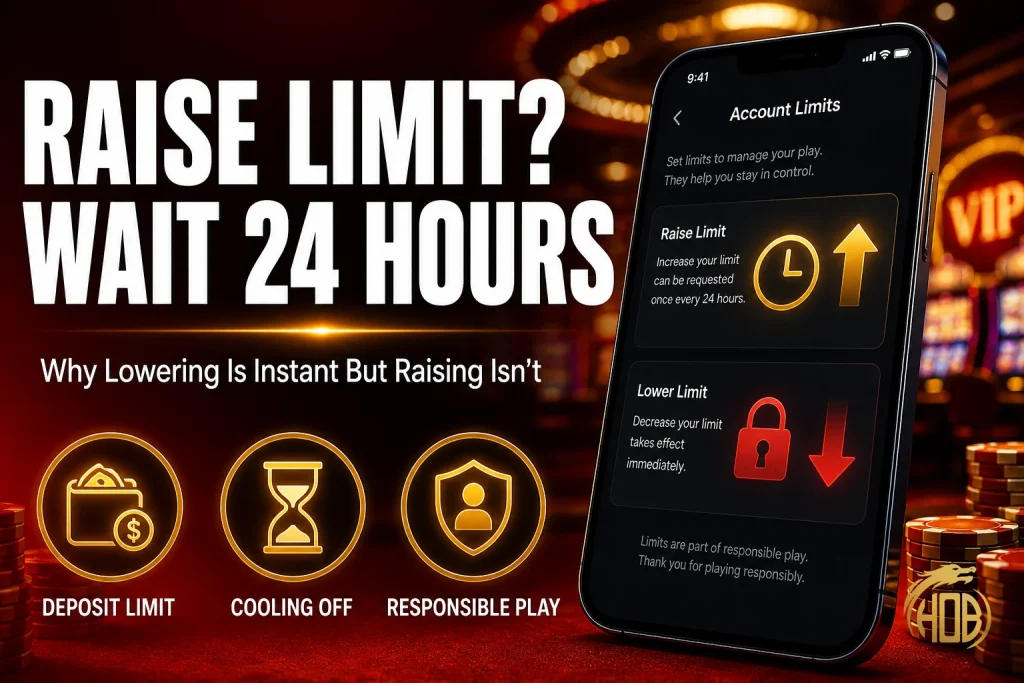

You go to raise your deposit limit for the month, expecting it to update the way most account settings do — instantly. Instead you get a message telling you the change won’t take effect for 24 hours. Lower the same limit, though, and it applies immediately, no delay at all. That’s not a bug, and it’s not the platform trying to slow you down for no reason. It’s a deliberate, one-directional piece of friction, and once you understand why it’s built that way, it stops feeling like an inconvenience and starts feeling like exactly the tool you’d want in the moment you’re most likely to make a decision you’ll regret.
The Rule, in Plain Terms
Reductions to a deposit limit take effect immediately. Increases only take effect after a cooling-off period — typically at least 24 hours — and even then only after you actively confirm you still want the increase once that period has passed. This isn’t a quirk of one particular platform; it’s the standard model used across regulated markets, most explicitly codified by the UK Gambling Commission’s rules on financial limits.
Under the Gambling Commission’s technical standards, operators must apply any customer-requested decrease to a limit “unless prevented by technical or system failures” — essentially instantly. Increases, by contrast, require a mandatory cooling-off period before the change applies, and the customer must take a separate, deliberate action to confirm the increase once that period ends. Further updates due to take effect from 30 June 2026 tighten the definition of what can even be labelled a “deposit limit” in the first place, so the term means the same thing everywhere a customer sees it.
| Direction | When It Applies | Operational Rationale & Safeguard Design |
| Lower your limit | Immediately | You should never face friction or delays when taking steps to protect your bankroll. |
| Raise your limit | After a cooling-off period (Typically 24+ hours + re-confirmation) | Eliminates emotional, heat-of-the-moment decisions and loss-chasing spikes. |
Why the Asymmetry Is the Entire Point
If raising and lowering a limit both happened instantly, the limit itself would be almost meaningless as a safeguard — you could set a conservative limit while calm, then remove it in seconds the moment you’re tempted to chase a loss or extend a session past what you’d planned. The friction only needs to exist in one direction, because the moment somebody wants to lower a limit, that’s already the outcome the tool is designed to support. The moment somebody wants to raise it, that’s precisely the moment worth slowing down.
This connects to a well-documented pattern in how people actually gamble: decisions made in the heat of a session — especially after a loss, or deep into a longer-than-planned sitting — are systematically less reliable than decisions made calmly beforehand. The World Health Organisation’s own guidance on gambling classifies impaired control over gambling behaviour as a core diagnostic feature of gambling disorder, precisely because the ability to stop or scale back in the moment is often the first thing that erodes. A 24-hour delay doesn’t remove your ability to raise your limit — it just moves that decision to a point where you’re no longer inside the exact moment the limit was set to protect you from.
Register at HengOngBet now and set your deposit limit while you’re calm and thinking clearly — that’s the version of the decision actually worth trusting.
What This Means Practically for Malaysian Players
Malaysia doesn’t have its own domestic regulator issuing rules like these for online casino operators, since the country licenses no online gambling platforms domestically. But the underlying logic isn’t UK-specific — it’s just sound design, and it’s exactly why the same asymmetric approach shows up across regulated platforms globally, regardless of which regulator wrote the rule first.
Practically, that means a few things worth planning around:
- Set your limit lower than you think you need, not higher. Since lowering is instant but raising isn’t, a slightly conservative starting limit costs you nothing if it turns out to be too tight — you can always request an increase and wait out the cooling-off period. Starting too high, on the other hand, gives you nothing to fall back on if a session starts going the wrong way.
- Don’t treat the 24-hour wait as an obstacle to work around. If you find yourself annoyed that a limit increase isn’t instant, that reaction is useful information — it usually means the limit is doing exactly its job at the exact moment you’re testing it.
- Revisit your limit when calm, not mid-session. Because the increase takes time regardless, there’s no benefit to requesting it while you’re already playing. Reviewing and adjusting limits as a deliberate, separate activity — outside of active play — is when the decision is actually reliable.
Join for free today and check your account’s limit settings now, before a session, rather than in the middle of one when the 24-hour delay will feel like the enemy instead of the safeguard it’s designed to be.
What to Do If You Keep Wanting to Raise Your Limit
If you notice a pattern of repeatedly hitting your limit and wanting it raised, that pattern itself is worth paying attention to — not because wanting more room is inherently a problem, but because a limit you keep needing to increase isn’t really functioning as a limit anymore. At that point, the more useful move isn’t finding a way around the 24-hour delay; it’s asking honestly whether the number you originally set reflected what you could actually afford, or what you hoped a good session might let you spend.
The Bottom Line
The 24-hour delay on raising a deposit limit isn’t a technical inconvenience — it’s a one-directional safeguard built specifically so that lowering your risk is always instant, while raising it always requires stepping outside the moment you’re in. Set your limit while calm, treat the delay as confirmation the tool is working rather than an obstacle, and if you find yourself wanting to raise it often, treat that pattern as the real signal worth examining.
Frequently Asked Questions
Why can I lower my deposit limit instantly but not raise it?
Because the two directions serve different purposes. Lowering a limit protects you, so it should never be delayed. Raising a limit removes a safeguard, so a cooling-off period — typically at least 24 hours, plus a confirmation step — is built in deliberately to prevent an impulsive in-the-moment decision.
Is this rule specific to one country or platform?
The clearest published version of this rule comes from the UK Gambling Commission’s technical standards for licensed operators, but the same logic is applied broadly across regulated platforms internationally, including operators serving Malaysian players, because the reasoning behind it isn’t jurisdiction-specific.
Can I bypass the 24-hour delay some other way?
No — and the entire point is that you shouldn’t be able to. If a platform lets you raise a limit instantly with no delay, that’s a sign the tool isn’t actually functioning as a safeguard.
Is a deposit limit the same as a loss limit?
No. A deposit limit caps how much you can put into your account over a period; a loss limit caps how much you can lose (winnings subtracted from spend) over that period. Some platforms offer both, and where they overlap, the stricter one applies.
What should I do if I keep wanting to raise my limit?
Treat it as useful information rather than a problem to solve around. Repeatedly needing a higher limit usually means the original number wasn’t set based on what you could genuinely afford — reviewing your budget honestly is more useful than finding a faster way to increase it.